How SmallSEOTools Plagiarism Detection Is Better Than Grammarly?
Plagiarism is a big concern for writers. They don’t want it to compromise their content. Therefore, they often use a plagiarism checker before publishing or submitting content.
However, not every plagiarism checker provides accurate reports. Some don’t detect obvious instances of plagiarism. Many flag original content. As a writer, you must pick the best tool to detect plagiarism. Many writers choose Grammarly.
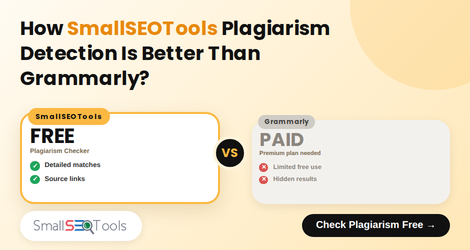
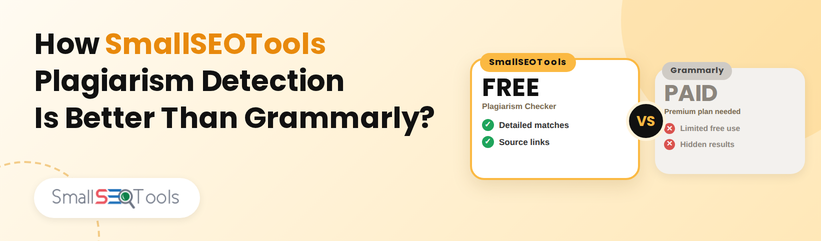
Grammarly is widely considered one of the best tools for improving writing, and it also offers plagiarism checking. However, it has some limitations. For instance, its plagiarism checker is not free to use, and it requires an account. Some writers also find its results less detailed than they need.
Consequently, many prefer SmallSEOTools over Grammarly. And that’s undoubtedly a great choice.
Below, we will explore how SmallSEOTools is better than Grammarly when it comes to detecting plagiarism.
Overview of Grammarly
Grammarly, as you might know, is primarily designed for writers to improve their content. It spots grammar, contextual, and structural issues in the content and provides suggestions to resolve them.
Grammarly has also added a few other features. Plagiarism checking is one of them. It’s very easy to use; after pasting or uploading your file to Grammarly, you just need to select the option, and Grammarly will check your content for plagiarism in no time.
A useful feature of Grammarly is that it allows you to make adjustments to the content in real time and updates results on the spot.
However, plagiarism detection is not Grammarly’s main purpose. And accuracy and detail are the main concerns when choosing a plagiarism checker. Users can overlook ease of use and other additional features, but they need dependable, detailed results. A tool built specifically for plagiarism detection can serve this need better.
Overview of SmallSEOTools
SmallSEOTools is basically a tool-based platform that offers a wide range of tools for different purposes. Its utilities can help website owners, freelancers, and even students in their work.
However, it’s particularly known for its plagiarism checker. This utility is also easy to use for everyone. Users don’t need to go through multiple steps. Instead, they just need to paste their text or upload a file, start the scan, and wait for the report, which lists the matched sources.
SmallSEOTools is also free to use. You can scan up to 1,000 words per check for free, and you can run as many checks as you need within fair usage. If you need to scan longer documents, premium plans offer larger scan limits and more advanced features. That’s why many freelancers and students rely on this platform to identify duplicate content in their text.
How SmallSEOTools Plagiarism Detection Is Better Than Grammarly?
Here is a quick comparison before we look at each point in detail.
| Feature | SmallSEOTools | Grammarly |
| Main purpose | Tool platform with a dedicated plagiarism checker | Writing improvement (grammar, style, structure) |
| Signup needed | No | Yes, an account is required |
| Plagiarism checker cost | Free (up to 1,000 words per scan); premium plans for larger limits | Paid subscription |
| Language support | 25+ languages | Primarily English |
No Signup Needed
SmallSEOTools provides instant access without requiring personal account creation. Users can start scanning text immediately upon visiting the website.
Grammarly, on the other hand, requires users to register an account before accessing its features. This step adds unnecessary delays for quick single-document checks.
Eliminating login requirements saves time for users needing immediate content verification results. Anyone can check plagiarism without signup and without sharing email addresses or personal information.
Free to Use
SmallSEOTools provides its scanning service without requiring subscription fees. Users can access matching details and source links without entering payment card information.
Grammarly locks its plagiarism checker behind paid subscription plans. Most users, especially students who only need to check one assignment, may find this hard to afford.
This free model helps students and freelancers manage budgets effectively. Users can review original source links without purchasing a premium membership.
Repeated Free Checks for Every Revision
SmallSEOTools lets you scan up to 1,000 words per check for free, and you can run repeated checks as you revise. Authors can test multiple versions of their text until it is original.
This helps students analyze their content as many times as they need. Freelancers can also use this facility to make their content more original without paying anything extra. When you need to check longer documents, premium plans are available with larger scan limits.
Detects Paraphrased Content
SmallSEOTools looks beyond identical wording. It also considers sentence structure and meaning, so text that has been reworded or had words swapped for synonyms can still be flagged.
That matters when you have rewritten a source and want to be sure your version doesn’t stay too close to the original.
Multi-Language Checking
SmallSEOTools can check plagiarism in 25+ languages. Choose your language from the dropdown before you start the scan, and the tool adjusts to how that language handles grammar and sentence structure. This means non-English writers can use the checker without trouble.
Grammarly focuses primarily on the English language. Broader language support makes the SmallSEOTools plagiarism checker a better choice for international users.
Extensive Database Coverage
SmallSEOTools checks your text against billions of online sources, including academic papers and published articles, so matches are searched across the open web and not only a small closed collection.
A broader search can support more comprehensive coverage across fast-changing internet publications. Writers receive findings that reflect available online content.
Customizable Scans and Downloadable Reports
SmallSEOTools also gives you control over what counts as plagiarism. With the Omit Citations option, properly quoted and referenced text is left out of the similarity score. Pre-Scan lets you include or leave out the content of a specific URL.
When the scan finishes, you can save the report as a PDF or Word file. It lists the similarity score, the matched sources, and the flagged passages, which makes it handy as proof of originality for teachers, clients, or editors.
Conclusion
Choosing the right plagiarism detection platform depends on individual workflow needs and budget limits. SmallSEOTools offers an accessible, free plagiarism checker with broad web coverage, paraphrase detection, and support for 25+ languages. Grammarly provides helpful style suggestions. Meanwhile, it restricts plagiarism checking to paid subscribers.
Content creators needing quick, detailed checks across multiple languages can benefit significantly from accessible web utilities. Evaluating these functional differences helps writers maintain original content standards efficiently without paying extra costs.